active
Warranty data
Factory files
An Onix Systems company · est. 2000
We automate warranty, serial-number and factory data flows for premium DACH manufacturers, from Excel exports to PIM-ready records.
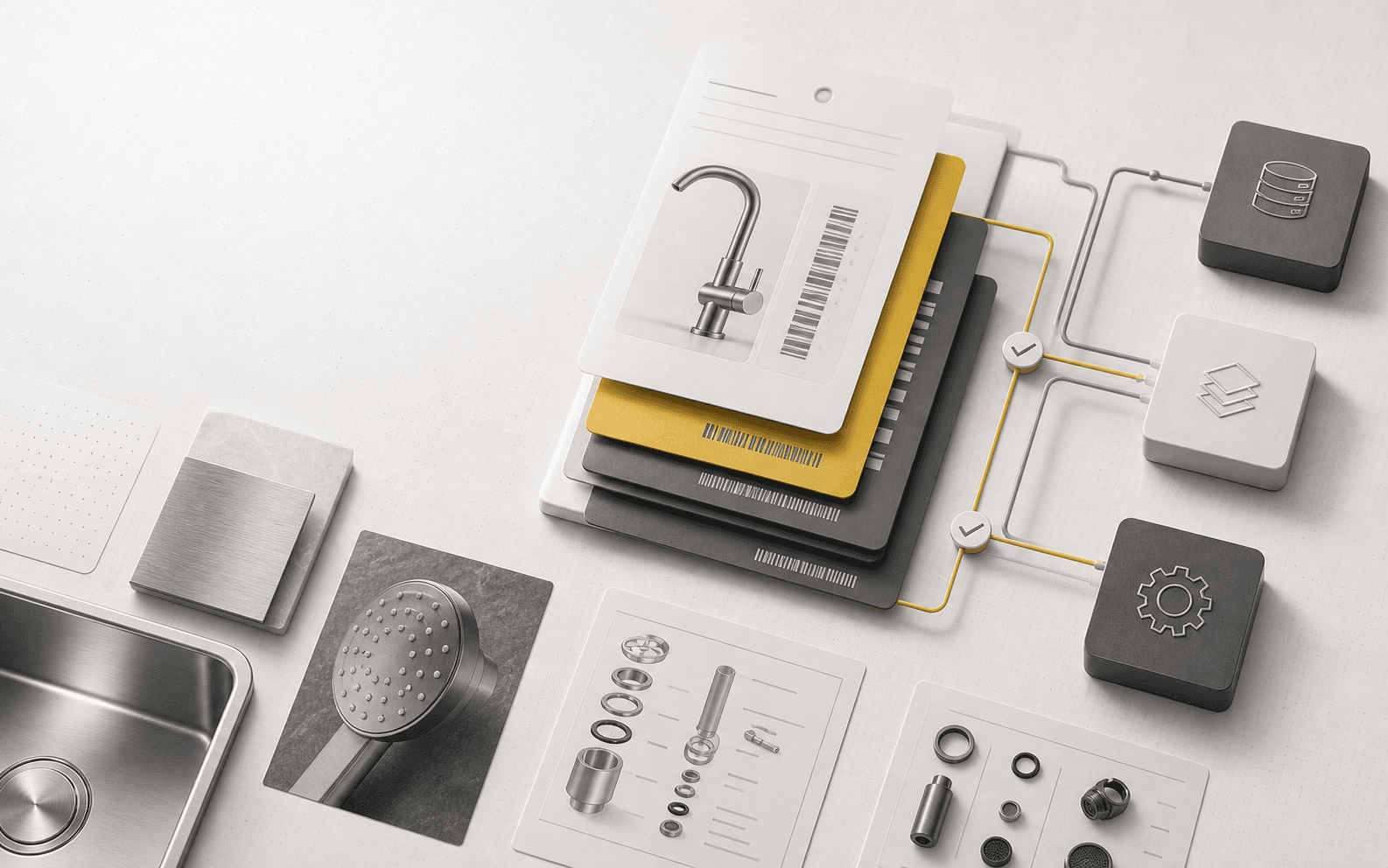
Warranty data
Factory files
PIM integration
API import
Clean, enriched records published directly into product data systems through agreed contracts.
Warranty data, by design. Not by spreadsheet.
Who we serve
Three buyer groups, three versions of the same risk: warranty data must be reliable when customers, dealers, installers or service teams need it.
Warranty is part of the premium promise. If the code cannot be found, the brand promise breaks at the service moment.
Service teams should help customers, not chase spreadsheets, factory contacts and missing serial records.
Factories rarely send one perfect format. We close ERP-adjacent gaps without turning the ERP into a custom project.
What you actually ship
File intake, validation, enrichment, PIM import, alerts, admin control. The operating posture premium manufacturers need when warranty data is tied to service quality.
Case studies
Four factories, four formats, zero manual import steps. Warranty data delivered to PIM within 14 days of production.
A governed layer checks file structure, fields, dates, serial numbers and enrichment dependencies upstream.
As-is mapping, to-be rules, API contracts and acceptance criteria are agreed before AI-supported development begins.
Services
Strategy, process design, engineering, QA and handover under one automation scope, with the same people carrying the workflow from messy file reality to production.
Turn factory-specific warranty exports into a governed pipeline that validates, transforms, enriches and publishes clean data to PIM, ERP and service teams.
Connect production data, product data and customer service workflows without forcing a heavy ERP customization project.
Validate files, fields, dates, warranty codes, serial ranges and enrichment dependencies before the data reaches downstream systems.
Map the as-is workflow, define the to-be automation and produce documentation detailed enough to become the instruction set for implementation.
Create secure internal portals and admin panels for warranty lookup, file review, exception handling and operational control.
Design lightweight partner workflows for serial verification, warranty registration, documentation lookup and issue escalation.
If you are stuck
Many premium manufacturers do not need a new ERP first. They need a precise audit of the flow ERP does not fully handle, then a scoped automation layer around real files.
What's new
The speed comes from precise process design. When the documentation is complete, AI can help build faster without inventing rules.
The as-is and to-be flow becomes the instruction set before development starts.
Precise specs let AI accelerate implementation without guessing business rules.
Factory-specific formats, required fields, edge cases and error states are explicit.
Wire parts files, attributes, manuals and product references are merged predictably.
Settings, recipients, file review and exceptions are visible to non-technical owners.
Teams receive documentation, configuration guidance and a supportable pipeline.
How we deliver
Warranty data moves through an engineering layer that validates, transforms, enriches and publishes records before they become operational truth.
How we deliver
Diagnosis first, scoped delivery second, measurable operation third. That order keeps automation precise instead of decorative.
Identify systems, owners, file flows, exceptions and the business cost of manual work.
Define data contracts, validation rules, enrichment logic, roles and acceptance criteria.
Implement the workflow layer, integrations, admin panel and notifications.
Test with actual factory exports, edge cases and stakeholder reviews.
Monitor results, improve quality and scale the pattern to more factories and processes.
Tools we work in
The point is not to replace the core system first. It is to close the manual gap around ERP, PIM, service and factory data with a supportable automation layer.
Recognition
Selected signals from Onix Systems and the manufacturing automation practice behind this offer.
Warranty automation across 4 factory flows with PIM integration, tested and confirmed on the client side.
Top global engineering firm for machine-learning delivery in Clutch's 2025 awards.
Verify2024 · top B2B providersFeatured on the Clutch 1000 list of top-rated B2B service providers globally.
VerifyEst. 2000 · 25+ years25+ years building custom software for complex business processes across manufacturing and industry.
VerifyInsights
Why premium manufacturers should treat warranty data as a customer experience asset, not a back-office artifact.
Read insightData quality · 6 min readA premium brand assumed its warranty numbers were complete. The systems said otherwise. What partial warranty coverage really costs, and how to close the gap.
Read insightModernization · 7 min readA practical decision framework for teams stuck between spreadsheet workarounds and a large platform replacement.
Read insightFree process audit
A focused review of your warranty, serial number, factory-file or PIM import process. You get a written flow map, risk list and fixed-scope delivery path.
Prefer email? Reach Tetiana at tetiana.kermach@onix-systems.com.
FAQ
If yours is not here, write to tetiana.kermach@onix-systems.com. Replies within 1 business day.
Warranty data, serial number flows, factory file intake, PIM imports, spare-parts enrichment, service notifications and partner workflows around ERP/PIM/customer service systems.
Usually no. We build the automation and integration layer around existing systems first, then recommend deeper platform changes only when the audit proves they are necessary.
A focused process triage can start in days. A production automation build typically follows after the operating spec is agreed and real files are available for validation.
Yes. The Duscholux case included four factory flows with different formats plus an additional enrichment step for one factory.
You do. We structure documentation, data contracts and code so your team can operate and extend the workflow after launch.
The first build is typically a fixed-scope, fixed-price engagement. It covers discovery sessions, process documentation, validation and transformation rules, the automation flow, a simple admin interface, error reporting, notifications, integration with one agreed target system, testing and handover. Full ERP/PIM implementations, historical data migration, customer-facing portals and BI dashboards are scoped separately.
A named process owner, example input files, a short description of the current process, a list of stakeholders, and access to the systems in scope. Validation rules and acceptance criteria are then agreed together during discovery, before implementation starts.
No. Warranty is the beachhead because it is high-value and visible to customers, but the same pattern applies to other operational data flows between factories, systems and service teams.